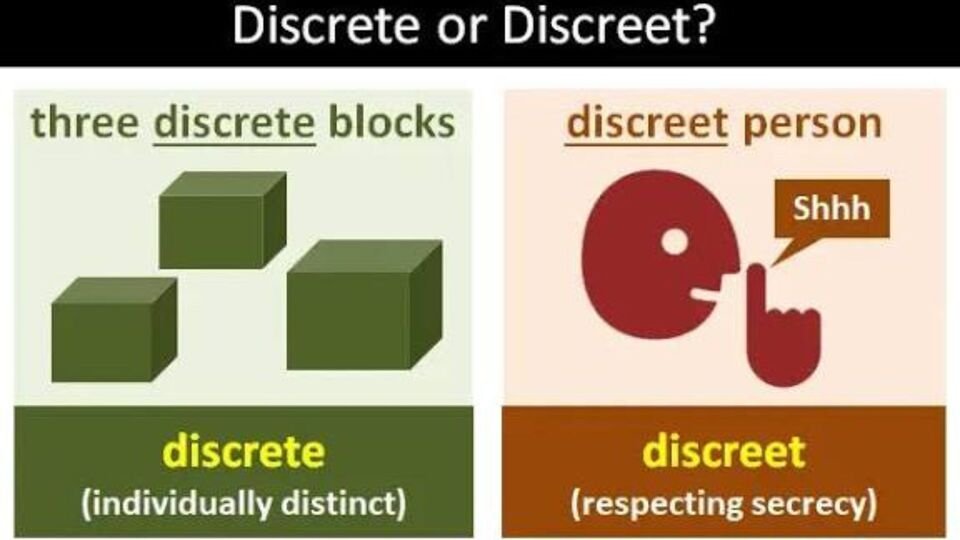
Have you ever written a sentence and wondered whether you should use discrete or discreet? These two words look almost identical, sound similar, and are often confused in everyday writing. However, they have completely different meanings and are used in different situations.
Understanding the difference between discrete and discreet can improve your grammar, communication, and professional writing. Whether you are writing an email, preparing a report, studying English, or improving your vocabulary, knowing when to use each word will help you avoid common mistakes.
In this complete guide, you will learn the meaning of both words, their origins, differences, examples, memory tricks, and answers to common questions people ask about discrete vs discreet.
Quick Facts / Overview
| Word | Meaning | Common Usage | Example |
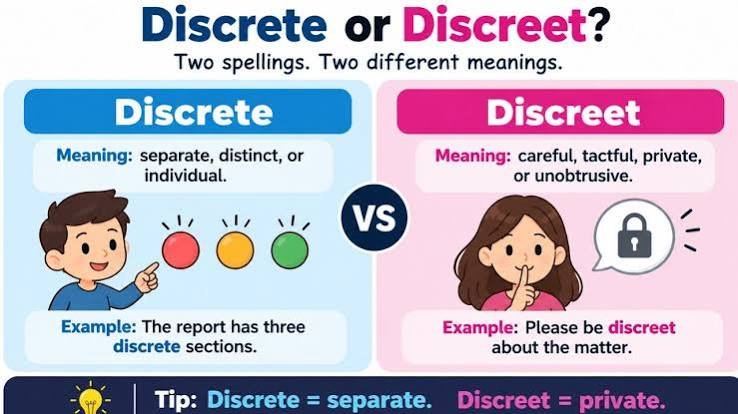
| Discrete | Separate, distinct, or individually different | Used for things that exist as separate units | The project has three discrete stages. |
| Discreet | Careful, private, or showing good judgment | Used for behavior, communication, or privacy | She was discreet about the confidential information. |
| Pronunciation | Both are pronounced similarly | Creates confusion among learners | dih-SKREET |
| Word Origin | Both come from Latin roots | Developed different meanings over time | Latin “discretus” |
| Main Difference | One means separate; the other means private | Context decides the correct word | Discrete parts vs discreet person |
What Does Discrete Mean?
The word discrete means something that is separate, individual, or clearly different from other things. It describes objects, ideas, categories, or parts that can be identified as separate units.
When something is discrete, it exists independently rather than being continuous or connected.
For example:
- A company may divide its services into discrete categories.
- A computer system may contain discrete components.
- Scientists may study discrete variables in research.
The opposite of discrete is often continuous, meaning something that flows together without clear separation.
Examples of Discrete in Sentences
- The machine is made of several discrete parts.
- The report contains five discrete sections.
- Each department performs a discrete function.
- The study examined discrete groups of participants.
In mathematics and science, discrete has a special meaning. A discrete value is something that can be counted, such as the number of students in a classroom or the number of cars in a parking lot.
What Does Discreet Mean?

The word discreet means being careful, tactful, or showing respect for privacy. It usually describes a person’s actions, words, or behavior.
Someone who is discreet knows how to handle sensitive information without causing embarrassment or problems.
For example:
- A doctor must be discreet when discussing patient information.
- A friend may be discreet about a personal secret.
- A professional employee should be discreet in workplace matters.
A discreet person uses good judgment and understands when something should remain private.
Examples of Discreet in Sentences
- She was discreet when discussing the family issue.
- The assistant handled the private conversation in a discreet manner.
- He made a discreet request to avoid attracting attention.
- The company promised discreet handling of customer information.
The opposite of discreet is usually indiscreet, which means careless, revealing, or lacking privacy.
Discrete vs Discreet: The Main Difference
The easiest way to understand the difference is:
- Discrete = Separate
- Discreet = Private or careful
Although they are spelled almost the same, their meanings are unrelated.
Discrete Examples
Think about things that can be separated:
- Discrete objects
- Discrete categories
- Discrete numbers
- Discrete stages
- Discrete sections
Example:
“The course is divided into four discrete modules.”
This means the modules are separate from each other.
Discreet Meaning
The word “discreet” describes someone who is careful about what they say or do, especially when a situation requires privacy. A discreet person knows how to handle sensitive information without attracting unnecessary attention. For example, if someone shares a personal secret with you, being discreet means keeping that information private and respecting their trust.
In everyday life, discretion is important in personal relationships, workplaces, and social situations. People often use this word when talking about private conversations, confidential matters, or someone who behaves thoughtfully without making others uncomfortable. In simple terms, discreet means being careful, respectful, and private.
Discrete or Discreet Packaging
When talking about packaging, the correct word is usually “discreet packaging.” It refers to a package designed to protect the customer’s privacy. The outside of the parcel generally does not reveal what is inside, and it may arrive in a plain box or an unmarked envelope without noticeable product branding.
Online shoppers often prefer discreet packaging when ordering personal, sensitive, or private products. It helps keep the contents confidential during delivery and avoids drawing unnecessary attention. The word “discrete” is different because it refers to separate or distinct things rather than privacy.
Discrete or Discreet Meaning
Although “discrete” and “discreet” look and sound almost identical, they have completely different meanings. Discreet means being careful, tactful, or private, while discrete means separate, individual, or clearly distinct. Understanding this difference can help you choose the correct word when writing or speaking English.
For example, you might say, “She was discreet about the private conversation,” because she kept the information confidential. On the other hand, “The project has three discrete stages” means that the project is divided into three separate parts. Both spellings are correct, but they are used in different situations.
Discreet vs Discrete Pronunciation
The words “discreet” and “discrete” have the same pronunciation in standard English. Both are pronounced /dɪˈskriːt/, with the main stress on the second syllable. This means you cannot usually tell which word someone means simply by listening to it.
The easiest way to distinguish them is by looking at the context and spelling. Discreet is commonly associated with privacy, careful behavior, and confidentiality, whereas discrete is used for separate items, distinct categories, or individual parts of something. Remembering their meanings is more useful than trying to distinguish their sounds.
Discrete or Discreet Synonym
The synonyms of “discreet” include tactful, careful, cautious, diplomatic, subtle, and private. These words describe someone who handles situations thoughtfully and avoids revealing unnecessary information. For example, a tactful person knows how to discuss a sensitive subject without embarrassing anyone.
The word “discrete” has a different set of synonyms, including separate, distinct, individual, independent, and detached. These words are useful when describing things that can be identified as separate units or parts. Choosing the right synonym depends on whether you are talking about privacy or separation.
Discrete or Discreet Relationship
In a relationship, the word “discreet” usually describes someone who respects their partner’s privacy and avoids sharing personal matters with other people. Being discreet can mean keeping private conversations confidential, respecting boundaries, and handling sensitive situations with care. It is often considered an important part of building trust between two people.
The word “discrete” has a different meaning in this context. It can describe separate aspects or stages of a relationship, such as emotional connection, communication, and shared responsibilities. Therefore, if you want to describe someone who keeps relationship matters private, “discreet” is the correct word.
Discrete or Discreet in a Sentence
Seeing both words in sentences makes their difference much easier to understand. For example, “Please be discreet about our private discussion” means that someone should keep the conversation confidential. Similarly, “He made a discreet effort to avoid attention” describes careful and subtle behavior.
For “discrete,” you could write, “The company operates in three discrete departments,” meaning that each department is separate from the others. Another example is, “The researcher collected data from five discrete groups.” These examples show why the spelling matters, even though both words sound the same.
Discrete or Discreet in Math

In mathematics, the correct term is “discrete.” It describes values or quantities that are separate and countable rather than continuous. Discrete mathematics includes topics such as integers, logic, graphs, sets, and combinations. These concepts are widely used in computer science, programming, and data analysis.
For example, the number of students in a classroom is a discrete value because you can count individual students. In contrast, measurements such as height or temperature can vary continuously within a range. The word “discreet” is not normally used in this mathematical sense because it refers to privacy and careful behavior.
Discreet Examples
Think about situations involving privacy:
- Discreet conversation
- Discreet behavior
- Discreet service
- Discreet person
Example:
“The employee was discreet about the company’s plans.”
This means the employee kept the information private.
Why Are Discrete and Discreet Confusing?
Many English learners confuse these words because they share the same pronunciation and have a similar spelling.
Both words come from the same Latin root, but their meanings changed over centuries.
The confusion happens because English contains many words called homophones or near-homophones, where words sound alike but have different meanings.
Other examples include:
- Their / There / They’re
- Affect / Effect
- Compliment / Complement
- Stationary / Stationery
Learning the context behind words is one of the best ways to avoid mistakes.
Origin and History of Discrete and Discreet
Both words come from the Latin word discretus, which means separated, distinguished, or divided.
Over time, English developed two different forms:
History of Discrete
The meaning of discrete stayed close to the original idea of separation and distinction.
It became associated with:
- Separate parts
- Individual units
- Clearly divided categories
Today, it is commonly used in science, mathematics, technology, and general descriptions.
History of Discreet
The meaning of discreet developed toward the idea of being thoughtful and careful.
It became connected with:
- Good judgment
- Privacy
- Sensitivity
- Responsible behavior
This difference shows how languages naturally change over time.
20 Interesting Facts About Discrete or Discreet
1. Both Words Share the Same Origin
Discrete and discreet both come from the Latin word “discretus.” Their meanings separated as English evolved, creating two different words from one historical source.
2. Discrete Means Something Can Be Separated
When something is discrete, it exists as an individual unit. This makes the word useful for describing objects, systems, and categories.
3. Discreet Relates to Privacy
Discreet is connected with careful behavior and protecting information. It is often used in professional and personal situations.
4. They Are Pronounced the Same
The similar pronunciation is one major reason people confuse these words. Context is the key to choosing the correct spelling.
5. Scientists Frequently Use the Word Discrete
In scientific writing, discrete describes separate measurements, groups, or values that can be counted individually.
6. Discrete Numbers Are Countable
In mathematics, discrete numbers represent separate values rather than continuous measurements. For example, the number of books on a shelf is discrete.
7. Discreet Is Important in Professional Settings
Doctors, lawyers, business leaders, and counselors often need to be discreet because they handle sensitive information.
8. The Words Are Not Interchangeable
Replacing one word with the other changes the meaning completely. A “discreet person” and a “discrete person” describe very different ideas.
9. Technology Uses Discrete Concepts
Computer systems often work with discrete data because digital information is represented through separate units.
10. Discreet Behavior Shows Respect
Being discreet can show maturity because it involves understanding when information should remain private.
11. Discrete Is Common in Academic Writing
Researchers often use discrete when explaining separate variables, groups, or categories.
12. Discreet Can Describe Actions
A person can make a discreet decision, discreet movement, or discreet request when they want to avoid attention.
13. The Words Have Different Opposites
The opposite of discrete is continuous, while the opposite of discreet is indiscreet.
14. Small Spelling Changes Can Create Big Meaning Differences
The single extra “e” in discreet changes the entire meaning of the word.
15. Context Helps Determine Meaning
Reading the full sentence usually makes the correct choice obvious because the meanings are completely different.
16. Discrete Appears in Data Science
Data analysts use discrete data when working with values that can be counted and separated.
17. Discreet Is Connected With Trust
A discreet person is often considered reliable because they respect confidentiality.
18. English Has Many Similar Word Pairs
Discrete and discreet are examples of confusing word pairs that require careful attention.
19. Both Words Are Common in Modern English
Although they have different meanings, both words appear frequently in professional and academic communication.
20. A Simple Memory Trick Can Prevent Mistakes
Remember: Discrete has “ete” like “separate” units, while discreet has extra “e” like “keep information secret.”
Common Uses of Discrete in Different Fields
The word discrete appears in many professional areas.
Mathematics
In mathematics, discrete refers to separate values that can be counted. Discrete mathematics studies topics such as logic, algorithms, and networks.
Science
Scientists use discrete to describe separate groups, measurements, or observations.
Technology
Digital systems often process discrete information because computers work with individual data units.
Business
Companies may organize operations into discrete departments, services, or processes.
Common Uses of Discreet in Daily Life
Discreet is mainly related to human behavior.
Workplace Communication
Employees may need to be discreet when handling private company information.
Personal Relationships
Being discreet can mean respecting someone’s personal matters.
Customer Services
Many businesses provide discreet services where privacy is important.
How to Remember the Difference Between Discrete and Discreet
Use these simple memory tricks:
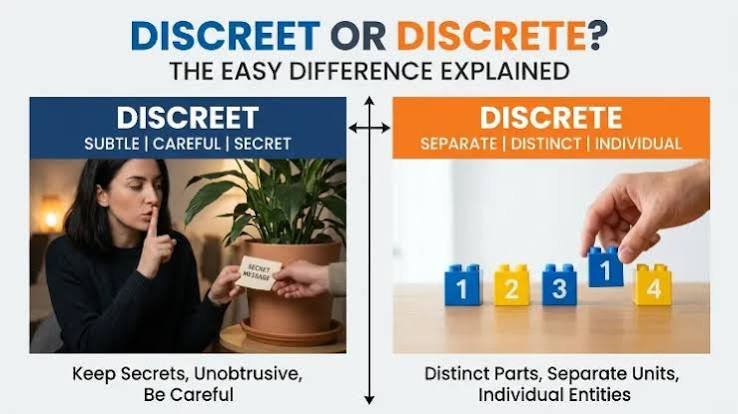
Discrete = Divide
Both words start with “dis,” but think of discrete as something divided into parts.
Example:
- Discrete sections
- Discrete groups
Discreet = Keep Secret
Think of discreet as keeping something hidden or private.
Example:
- Discreet conversation
- Discreet person
Another helpful reminder:
- Discrete has separate pieces.
- Discreet has secret behavior.
Frequently Asked Questions (FAQ)
What is the difference between discrete and discreet?
Discrete means separate or individual, while discreet means careful, private, or showing good judgment.
Are discrete and discreet pronounced the same?
Yes, both words are usually pronounced the same way, which is why they are commonly confused.
Is a person discrete or discreet?
A person is usually discreet because it describes someone who is careful with information or behavior.
What is an example of discrete?
“The company has three discrete departments.” This means the departments are separate from each other.
What is an example of discreet?
“She was discreet about the confidential information.” This means she kept the information private.
Is discrete the opposite of continuous?
Yes, in many contexts, discrete is the opposite of continuous because discrete things are separate rather than connected.
Why do people confuse discrete and discreet?
People confuse them because they look and sound almost identical, but their meanings developed differently over time.
Conclusion
Understanding discrete or discreet becomes much easier when you remember their core meanings. Discrete refers to things that are separate, individual, or divided into parts. Discreet describes someone or something that is careful, private, and respectful of confidentiality.
Although these words share the same origin and pronunciation, they serve completely different purposes in English. Learning this difference will help you write more accurately and communicate with greater confidence.
The next time you are unsure, remember the simple rule: discrete means separate, while discreet means secret or careful.

Hi, I’m Sophia Carter. I love writing heartfelt quotes that encourage kindness, confidence, and self-belief. I believe every person has a unique story, and the right quote can remind someone of their strength when they need it most.
I enjoy exploring topics like love, friendship, family, mindfulness, and personal development. My mission is to create words that inspire people to smile, reflect, and move forward with hope.
Books I Have Written:
- Finding Light in Every Moment
- A Journey of Hope and Happiness
 Noah Bennett